


VFEX Changes Market Cap Rules for Cross-Listed Companies
TLDR
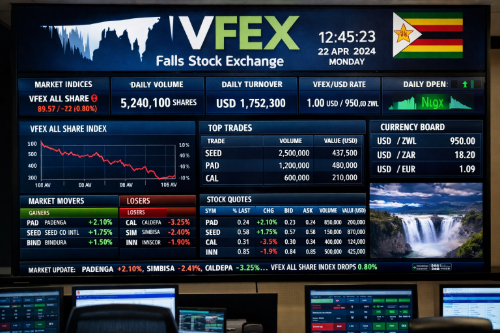
- Victoria Falls Stock Exchange (VFEX) has changed its method to calculate market capitalization by multiplying VFEX share price by total issued shares, boosting reported market values without additional shares traded.
- Old Mutual saw a significant increase in market capitalization on VFEX after the new calculation method was applied.
- The rule change affects cross-listed companies like Kavango Resources, aligning VFEX calculations with global market conventions for improved comparability.
Zimbabwe’s Victoria Falls Stock Exchange has changed how it calculates the market capitalisation of companies listed on both VFEX and another recognised exchange. From August 13, the exchange will multiply the VFEX share price by a company’s total issued shares rather than only the shares represented on the local market.
The change means reported market values can rise without any increase in the number of shares available for trading on VFEX. If a company has 1 billion shares globally but only 100 million are represented on VFEX, a VFEX price of $1 will now produce a market capitalisation of $1 billion instead of $100 million.
The impact was seen after Old Mutual resumed trading on VFEX. The new methodology helped lift the exchange’s reported market capitalisation from about $4.17 billion to $7.74 billion. Old Mutual accounted for about $3.61 billion, or 46.6%, of the total under the new calculation.
Kavango Resources is another cross-listed company affected by the rule. The company has its main listing in London and a secondary listing on VFEX. The change allows VFEX to value the entire issued share base using its local price even though only part of those shares may be available on the Zimbabwean market.
VFEX said the method brings its calculations closer to market conventions used elsewhere and improves comparisons between cross-listed companies. The change does not make additional shares tradable on VFEX, and the exchange can use another method where it believes the standard calculation does not provide a fair measure of market value.
Points clés à retenir
The rule makes VFEX look much larger, but investors should separate market capitalisation from the size and liquidity of the local market. Market capitalisation measures the implied value of an entire company, while local liquidity depends on how many shares are actually available and how much investors trade. Under the new method, VFEX can count the full global value of Old Mutual even though only part of Old Mutual’s shareholder base is represented in Zimbabwe. That is why the exchange’s reported value jumped to $7.74 billion without billions of dollars of new capital entering the market. The approach is common when discussing a company’s total equity value, but it can make exchange-level comparisons harder if users assume every share included in the calculation is locally tradable. The change also comes as VFEX attracts cross-listed and migrating companies because it trades in US dollars, giving issuers and investors less exposure to Zimbabwe’s local currency. For data providers and investors, the main point is to look beyond headline market capitalisation. Turnover, free float, locally registered shares and trading volumes remain better measures of how much capital can move through the exchange at any given time.
Vous pensez que quelqu'un d'autre devrait voir ça ?









Investir dans cette opportunité et dans d'autres opportunités à travers l'Afrique
Téléchargez l'application daba finance sur votre mobile via

Passer à l'action.

Télécharger l'application

Entrez en partenariat avec nous
Débloquez des opportunités commerciales passionnantes et un potentiel de croissance.
Rejoindre Daba
Devenez membre de notre communauté dynamique et profitez d'avantages exclusifs.
Contactez-nous
Contactez-nous pour toute demande de renseignements, assistance ou collaboration.