


Dangote Refinery Seeks $1B in Private Debt Sale
TLDR
- Dangote Refinery plans to raise $1 billion through a private debt sale for expansion and funding of its operations, showcasing a strategic move toward capital-market expansion.
- The refinery aims to increase its capacity to 1.4 million barrels per day by 2028, positioning itself as one of the world's largest refining hubs.
- Investment in Dangote Refinery presents an opportunity for investors to gain exposure to a critical energy asset in Africa, although expansion plans come with operational challenges and market risks.
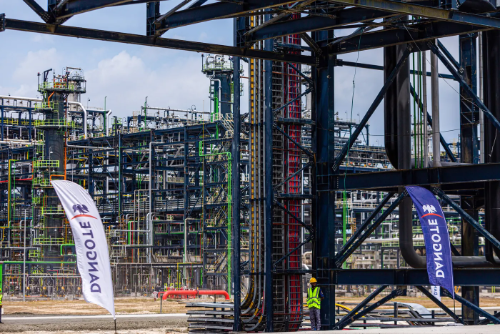
Dangote Petroleum Refinery is seeking to raise as much as $1 billion through a private debt sale to foreign investors as it expands production and funding plans.
The refinery, owned by Aliko Dangote’s group, is Africa’s largest crude-processing facility. It has an official capacity of 650,000 barrels per day but has recorded test runs of about 700,000 barrels per day.
The plant produces petrol, diesel and jet fuel for Nigeria and exports to markets across Africa, Europe, the US and Saudi Arabia. Demand for its products has grown as global energy supply routes face pressure from geopolitical tensions in the Middle East.
The planned debt raise is part of a wider capital strategy. The refinery is also pursuing a private share placement that reportedly drew as much as $2 billion in investor demand and is expected to move toward a future public listing. Dangote Fertiliser raised $750 million through a private placement in April, marking the group’s first move into international debt markets.
Dangote Industries plans to invest at least $40 billion over the next 5 years. The group wants to expand refinery capacity to 1.4 million barrels per day by 2028, which would make it one of the world’s largest refining hubs. It is also exploring a deep-sea port, liquefied gas projects, fertiliser expansion, a 20,000-megawatt power plant and a possible refinery in East Africa.
Key Takeaways
Dangote Refinery’s debt raise shows how the group is moving from project completion to capital-market expansion. The refinery has become a strategic energy asset for Nigeria and Africa because it can reduce dependence on imported fuels while creating export revenue. But scaling a facility of this size requires large and repeated funding. Debt can help finance expansion without immediately diluting shareholders, while the private share placement and future IPO could broaden the ownership base later. The 700,000-barrel-per-day test run strengthens the investment case because it shows the refinery may operate above its original design capacity. Still, the growth plan is ambitious. Expanding to 1.4 million barrels per day by 2028 will require crude supply, storage, logistics, ports, distribution, regulatory support and stable operating cash flow. For investors, the opportunity is exposure to one of Africa’s most important industrial assets. The risk is execution in a market shaped by fuel pricing, foreign exchange constraints, debt costs and global oil cycles.
Think someone else should see this?









To invest in this opportunity and other opportunities across Africa
Download the daba finance app on your mobile through


Take action.

Download app

Partner with us
Unlock exciting business opportunities and growth potential.
Join Daba
Become a part of our vibrant community and enjoy exclusive benefits.
Contact us
Reach out to us for inquiries, support, or collaboration.