


Morocco Overtakes South Africa as Africa's Most Industrialised Economy
TLDR
- Morocco surpasses South Africa in the Africa Industrialisation Index for 2025, thanks to sustained industrial policy and manufacturing growth in automotive, aerospace, and infrastructure sectors.
- AfDB's report highlights that North and Southern Africa lead in manufacturing output, while intra-African trade remains low at 14.4% of total trade.
- South Africa's decline is attributed to issues with power utility Eskom, Transnet's rail network breakdown, and the need for significant infrastructure investments to meet 2030 goals.
Morocco has displaced South Africa at the top of the African Development Bank's Africa Industrialisation Index for 2025, ending a 15-year run for South Africa as the continent's leading industrial economy. The AfDB, which unveiled the report at its Annual Meetings in Brazzaville, credited Morocco's rise to sustained industrial policy, export diversification, and manufacturing growth across automotive, aerospace, and infrastructure sectors.
The rest of the top 10 comprises Egypt, Tunisia, Mauritius, Algeria, Eswatini, Senegal, Namibia, and Côte d'Ivoire. The index assessed industrial development across 54 African countries between 2010 and 2024 and found that 41 improved their industrialisation scores, with Africa's overall industrial performance rising 6%. North and Southern Africa continue to dominate manufacturing output and export sophistication, while intra-African trade remains a structural weakness at just 14.4% of total trade.
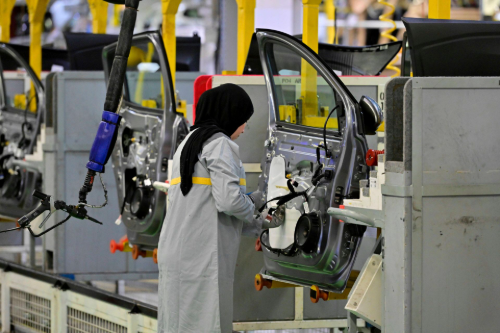
Morocco's ascent is the product of two decades of policy execution. The automotive sector — now the country's largest export industry — produced 493,004 passenger cars in 2025, surpassing South Africa's 329,600 units. Automotive exports to the EU reached €15.1 billion in 2023. The aerospace sector, home to over 150 companies including Boeing, Airbus, Safran, and Thales, generated $2.87 billion in exports in 2024, up from $839 million a decade earlier. Infrastructure investments — Tanger Med port, the Al Boraq high-speed rail line, and the Nador West Med complex — have reinforced Morocco's position as a manufacturing and logistics hub connecting Europe, Africa, and the Middle East.
South Africa's decline centres on the collapse of two state monopolies. Power utility Eskom's chronic outages have forced manufacturers into costly self-generation, while the breakdown of Transnet's rail network has pushed freight onto roads and created port bottlenecks at Durban and Cape Town. GDP has grown at under 1% annually on average over the past decade, and gross fixed-capital formation contracted in 3 of 4 quarters in 2024. President Ramaphosa has estimated the country needs R1.6 trillion ($99 billion) in public infrastructure investment and R3.2 trillion from the private sector to meet its 2030 infrastructure goals.
The AfDB said Africa's industrial future depends on reliable energy, stronger infrastructure, technical skills, financing, and deeper regional integration under the African Continental Free Trade Area. "The continent's real deficit is no longer an absence of industrial strategies," said Harouna Kaboré, who contributed to drafting the report. "What is still lacking is rigour in implementation."
Key Takeaways
The Morocco-South Africa ranking reversal is both a story of one country's rise and another's institutional failure. Morocco's industrial strategy, anchored in royal commitment since the early 2000s, has been unusually consistent by African standards — surviving government changes, external shocks, and the COVID disruption — because it is insulated from electoral cycles in a way that democratic South Africa's policy framework is not. The result is a manufacturing base that has compounded over two decades: automotive from near zero to nearly 1 million units per year, aerospace from a cottage industry to a $2.87 billion export sector, and phosphate-derived chemicals that feed global fertiliser markets. South Africa, by contrast, has seen Eskom's debt — now over 400 billion rand — act as a fiscal anchor that crowds out the infrastructure spending needed to keep heavy industry competitive, while Transnet's deterioration has added a logistics tax on every manufacturer in the country. The AfDB report's finding that intra-African trade stands at just 14.4% of total trade underscores a systemic problem that neither Morocco's success nor South Africa's decline resolves: African manufacturers still export primarily to Europe and Asia, sell commodities rather than finished goods, and operate in supply chains that bypass neighbouring countries entirely. AfCFTA, now in its implementation phase, is the structural mechanism designed to change that — but its traction depends on the same energy, logistics, and institutional capacity that the index identifies as Africa's core industrial deficits.
Think someone else should see this?









To invest in this opportunity and other opportunities across Africa
Download the daba finance app on your mobile through


Take action.

Download app

Partner with us
Unlock exciting business opportunities and growth potential.
Join Daba
Become a part of our vibrant community and enjoy exclusive benefits.
Contact us
Reach out to us for inquiries, support, or collaboration.