


Nigerian Stocks Fall 0.97% as Banking, Oil Shares Lead Declines
TLDR
- Nigerian stocks fell for a second week due to losses in banking, oil, and major sectors.
- NGX All-Share Index declined by 0.97% and market capitalization dropped to ₦161.26 trillion.
- Market breadth weakened with fewer stocks gaining, while banking and oil & gas sectors saw significant declines.
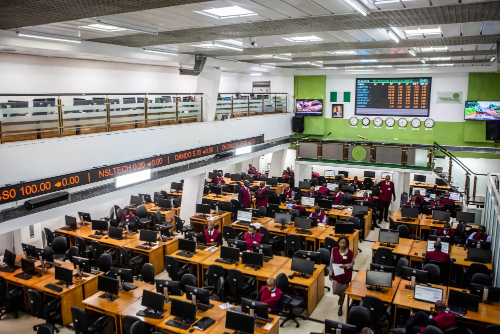
Nigerian stocks fell for a second week as losses in banking, oil and other large sectors pushed the market lower. The NGX All-Share Index declined 0.97% to 248,363.55 points in the week ended October 9, while market capitalization fell to ₦161.26 trillion. The benchmark remained up 59.60% in 2026 despite the weekly decline. The NGX 30 lost 0.99%, while the Premium Index fell 0.64%.
Market breadth weakened. Only 24 stocks gained during the week, down from 44 the previous week, while 54 declined and 68 were unchanged. The Banking Index fell 2.64% and the Oil & Gas Index dropped 3.85%, the largest decline among the main equity sector indices. Consumer goods fell 0.58%, while the Industrial Goods Index was the only major equity index to rise, gaining 0.02%.
Investors traded 2.715 billion shares worth ₦158.28 billion in 209,986 deals, compared with 3.166 billion shares worth ₦155.02 billion the previous week. Financial services accounted for 73.84% of trading volume and 52.39% of value. Access Holdings, Zenith Bank and United Bank for Africa accounted for 1.02 billion shares worth ₦50.52 billion, or 37.56% of total market volume and 31.92% of value.
Livestock Feeds led gainers with a 47.75% rise to ₦13.15. Tripple Gee and Company gained 32.62% to ₦3.09 and Guinea Insurance rose 29.17% to ₦0.93. Critical Minerals Financing Corp led declines, falling 20.27% to ₦3.58. ABC Transport dropped 18.24%, while Fidelity Bank lost 10.64% to ₦21. Aradel Holdings declined 10% to ₦1,377.
The week also included several market changes. The NGX listed 2 Federal Government savings bonds carrying coupons of 14.12% and 15.12%, while Guinea Insurance added 6.31 billion shares from a private placement. Trading in Multi-Trex Integrated Foods resumed after the company filed outstanding financial statements. Sterling Financial Holdings also completed a share reconstruction, replacing 68.5 billion existing shares with 6.85 billion shares priced at ₦77 each.
Key Takeaways
The latest decline shows that selling pressure has spread across more of the Nigerian market after the gains recorded earlier in 2026. The All-Share Index remains up 59.60% for the year, but the number of weekly gainers fell to 24 from 44 while decliners rose to 54 from 37. That change in market breadth matters because the weakness was not limited to a few stocks. Banking, which remains one of the most traded parts of the market, fell 2.64%, while oil and gas dropped 3.85%. Even after that decline, the Oil & Gas Index is still up 124.92% in 2026 and the Banking Index has gained 72.50%, leaving investors with large gains to protect after the year’s rally. Trading also remained concentrated in financial stocks. Access Holdings, Zenith Bank and UBA alone represented more than 37% of market volume, while financial services accounted for almost 74% of all shares traded. That concentration means moves in a small number of banks can still have a large effect on overall activity. The market is also seeing changes in listed securities, with new government bonds, private-placement shares and Sterling Financial Holdings’ share reconstruction adding to trading activity. For investors, the main question is whether the recent weakness develops into a broader correction or remains a pause within a market that is still up close to 60% this year. The answer will depend on earnings, interest rates, sector valuations and whether buying returns to large banking and oil stocks.
Companies in this story
Think someone else should see this?









To invest in this opportunity and other opportunities across Africa
Download the daba finance app on your mobile through

Take action.

Download app

Partner with us
Unlock exciting business opportunities and growth potential.
Join Daba
Become a part of our vibrant community and enjoy exclusive benefits.
Contact us
Reach out to us for inquiries, support, or collaboration.